
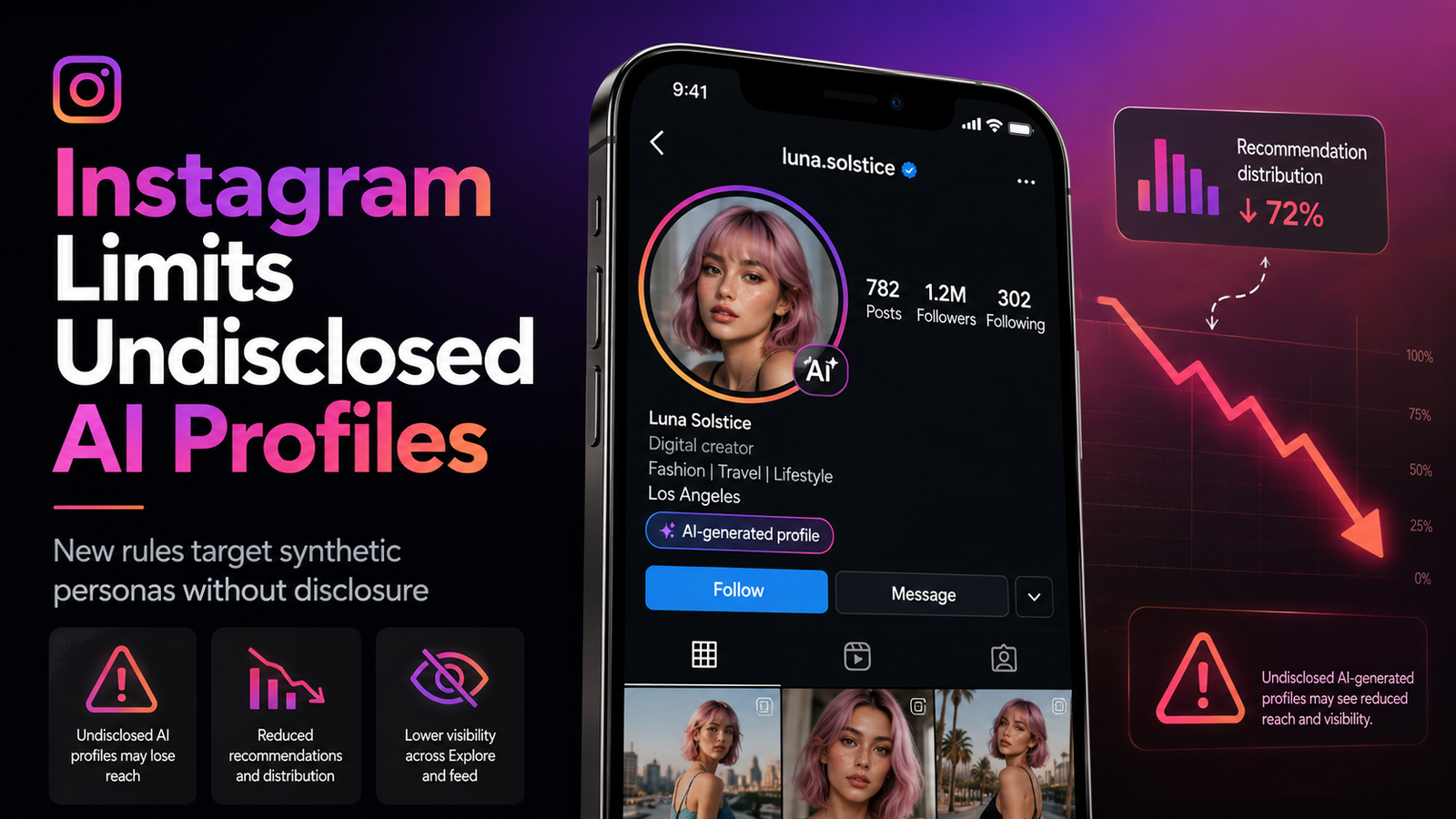
Instagram is tightening its rules for AI-generated personas by introducing a clearer “AI-generated profile” label and limiting recommendation reach for accounts that feature synthetic people without disclosure. The change draws a sharper line between AI-assisted content creation and profiles built around people who do not actually exist.
Editorial analysis is kept separate from provider claims and measured results. Automated tools may assist organization or drafting, while factual claims remain subject to sourcing and correction controls.
Editorial guidelines•Sourcing & verification•CorrectionsInstagram is drawing a clearer line around AI-generated identities
Instagram is introducing stricter transparency rules for profiles built around AI-generated people, moving beyond simply labeling individual pieces of synthetic content. The platform is renaming its existing “AI creator” profile label to “AI-generated profile” and says accounts that feature an AI-generated person without properly identifying that fact may have their reach limited.
The change targets a specific problem: profiles that look as though they belong to real people even though the person presented in the account is substantially or entirely generated with artificial intelligence. Instagram says users want clearer information when they encounter these synthetic identities rather than discovering later that the person they were following was not real.
What is changing on Instagram?
The most visible change is the name of the disclosure itself. “AI creator” could describe a real creator who simply uses generative AI in their workflow. “AI-generated profile” is much more specific: it tells users that the person represented by the account is AI-generated.
That distinction matters because Instagram is not introducing a blanket penalty for creators who use AI.
A photographer who uses AI-assisted editing, a marketer who generates graphics, or a creator who uses an AI writing assistant for captions does not automatically need to identify their entire profile as AI-generated. The profile-level disclosure is aimed at accounts where the person or character presented as the identity of the profile is synthetic.
Undisclosed AI profiles can lose recommendation reach
The more significant part of Instagram’s update is enforcement.
If Instagram identifies a profile featuring an AI-generated person but the creator has not applied the appropriate disclosure, the account can lose eligibility for recommendations. That can reduce exposure to people who do not already follow the account, including discovery surfaces such as Reels and Explore.
Creators who proactively apply the AI-generated profile label are not supposed to lose reach simply because they operate an AI persona. The issue is therefore not the existence of an AI influencer itself; the issue is whether users are being clearly told what they are seeing. Accounts that believe they were classified incorrectly can also challenge the decision.
This makes disclosure more than a cosmetic profile setting. For AI influencers and agencies managing virtual personalities, transparency can now directly affect distribution.
AI-assisted creator or AI-generated persona?
One of the strongest aspects of the new policy is that it separates AI-assisted creation from synthetic identity.
Generative AI has become part of everyday creative workflows. Images may be retouched with AI, backgrounds may be generated, captions can be rewritten, and videos can contain synthetic elements without the creator themselves being fictional.
Instagram’s new profile label is not intended to classify all of those users as AI-generated creators.
Instead, it focuses on accounts where the apparent human identity itself is generated. That could include a virtual fashion influencer, fictional lifestyle personality, synthetic spokesperson, or other realistic AI character presented consistently as the face of an account.
How this differs from Instagram’s existing “AI info” labels
Meta already has a broader system for identifying AI-created or significantly altered media on Facebook, Instagram and Threads.
The company has said it uses a combination of self-disclosure and industry-standard technical signals to identify AI-generated content. Depending on how substantially AI was involved, users may see “AI info” associated with a post. Meta previously changed its labeling approach after finding that some content with relatively minor AI edits was being labeled in ways that users could misunderstand.
The new Instagram profile rule addresses a different layer.
An AI info label can describe how a particular image, video or audio item was produced.
An AI-generated profile label describes the identity represented by the account.
That distinction could become increasingly important as AI-generated influencers become visually harder to distinguish from real people.
Why Instagram is acting now
Synthetic influencers are no longer experimental curiosities. Generative image and video systems can create realistic characters, maintain a consistent visual identity and produce a continuous stream of lifestyle content at relatively low cost.
That creates opportunities for entertainment and marketing, but it also creates authenticity problems.
A user may follow an account, trust recommendations, engage in direct messages, or respond to health, lifestyle or commercial claims without realizing that the supposed person behind the account is fictional. Recent reporting has highlighted concerns around networks of AI-generated personalities being used for promotion and around synthetic health or wellness personas presenting authoritative-looking content.
Instagram’s response does not ban AI influencers. Instead, it attempts to make disclosure part of the cost of participating in the platform’s recommendation system.
What AI influencers and brands should do
For creators operating a clearly synthetic persona, the safest strategy is now straightforward: disclose it.
Agencies and brands working with virtual influencers should also treat the account’s AI status as part of campaign governance rather than an optional biography detail. If Instagram believes an account should carry the AI-generated profile label and it does not, losing recommendation eligibility could materially affect campaign reach.
Creators who are real people but use AI tools in production should not over-interpret the change. The policy, as currently described, does not require every account that uses generative AI somewhere in its workflow to identify itself as an AI-generated profile.
A broader shift toward AI identity disclosure
Meta has been moving toward more explicit AI transparency for several years. Its existing content-labeling framework already distinguishes AI-generated media and provides additional information when synthetic content is detected or disclosed. Meta has also continued to expand AI transparency requirements in areas such as advertising and political content.
Instagram’s latest change pushes that approach from individual content into account identity.
That may be the more consequential development.
As AI agents, virtual influencers, synthetic presenters and digital characters become more common, platforms may increasingly need to answer not only “Was this post generated by AI?” but also “Is the person behind this profile real?”
AI Orbit take
Instagram is not rejecting AI-generated creators; it is making undisclosed synthetic identity more costly.
That is an important distinction. Generative AI can remain part of legitimate creative and commercial activity while platforms demand clearer disclosure when an artificial persona could reasonably be mistaken for a real person.
For creators, the immediate consequence is recommendation reach. For the wider AI ecosystem, the bigger signal is that AI identity transparency is becoming a platform-level policy issue rather than a voluntary creator convention.
If other major social platforms follow a similar model, explicit disclosure of synthetic personas could eventually become a standard part of how AI-generated accounts operate online.

