
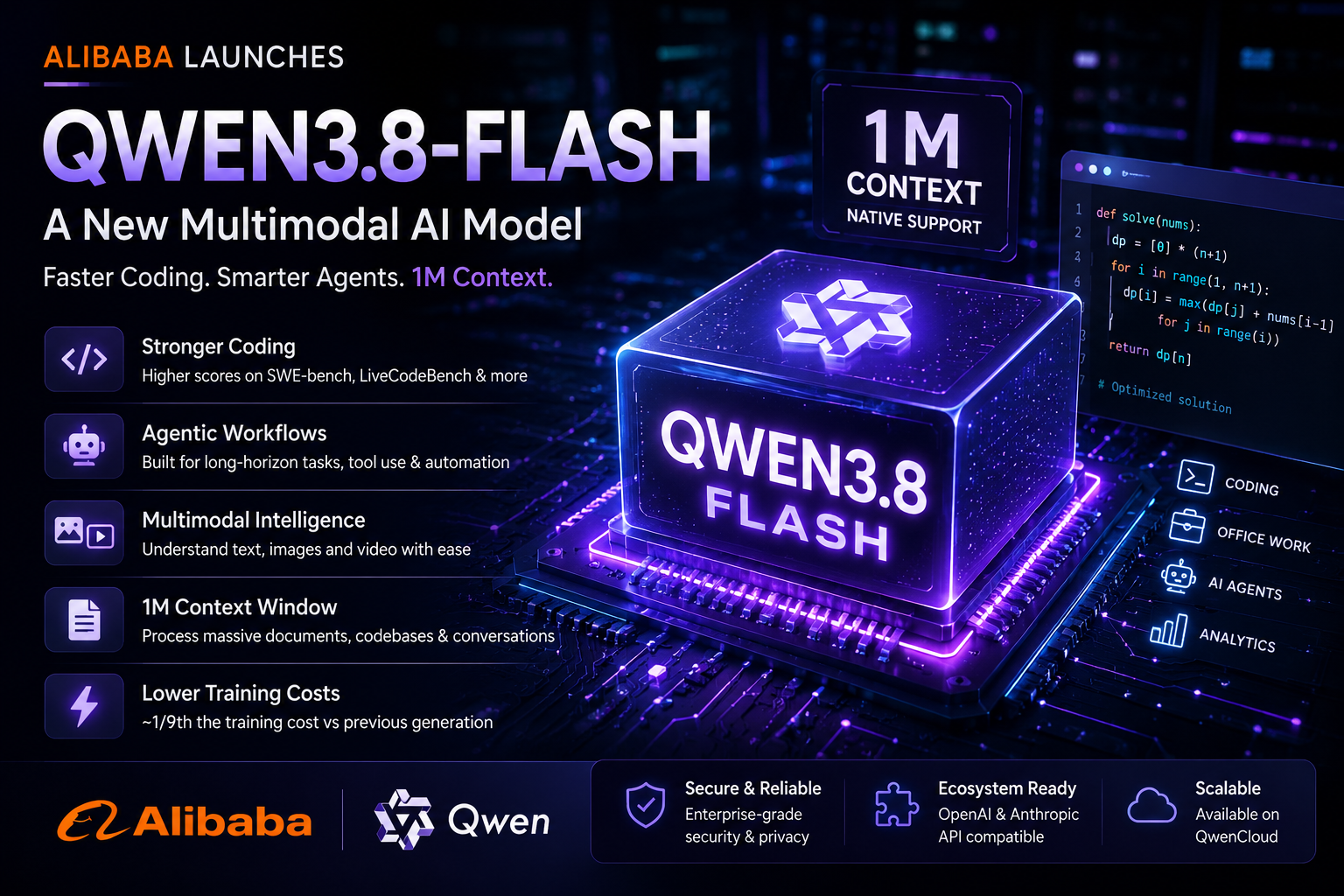
Alibaba’s Qwen has launched Qwen3.8-Flash, a new multimodal AI model focused on coding, agentic workflows and office automation. The release supports up to a 1-million-token context window and introduces architectural ideas that point toward the future Qwen4 family.
Editorial analysis is kept separate from provider claims and measured results. Automated tools may assist organization or drafting, while factual claims remain subject to sourcing and correction controls.
Editorial guidelines•Sourcing & verification•CorrectionsAlibaba Launches Qwen3.8-Flash: 1M Context, Faster Coding and a Preview of Qwen4
Alibaba’s Qwen team has released Qwen3.8-Flash, a new multimodal AI model designed to combine strong reasoning and generation capabilities with speed and cost efficiency.
Released on August 26, 2026, Qwen3.8-Flash targets demanding workloads including software development, agentic workflows, long-document processing, office automation and visual understanding. Alibaba’s official documentation lists the model for text generation, deep thinking and visual understanding, while Reuters reported that the company is positioning it as an improvement in coding and office-related tasks.
The release is particularly significant because Qwen is not simply introducing another incremental Flash model. Alongside the production model, the company has opened Qwen3.8-Flash-Next, an architectural preview containing technologies expected to influence the upcoming Qwen4 generation.
What is Qwen3.8-Flash?
Qwen3.8-Flash is Qwen’s latest multimodal Flash-class model. It can work across text, images and video while targeting applications where both capability and efficiency matter.
One of its biggest features is long-context processing. Alibaba's documentation says Qwen3.8-Flash natively supports a 1-million-token context window in its managed offering, making it suitable for processing extensive documents, large codebases and lengthy conversations.
That opens several practical use cases: developers can provide substantially more repository context during coding tasks, businesses can analyze large collections of documents, and AI agents can retain more information while completing long-running workflows.
Qwen3.8-Flash-Next gives an early look at Qwen4
Perhaps the most interesting part of the announcement is Qwen3.8-Flash-Next.
Qwen describes Flash-Next as a multimodal mixture-of-experts model and an early preview of architecture being developed for Qwen4. Its main model contains 125 billion parameters, with an additional 51 billion parameters used for N-gram embeddings, while only around 6 billion parameters are activated per token.
The architecture introduces changes across four major areas: attention, residual connections, embeddings and optimization.
For attention, Qwen combines Gated DeltaNet (GDN) with Qwen Sparse Attention (QSA). The company says this architecture is designed to efficiently retain historical information while selectively retrieving important context from long sequences.
Qwen is therefore using the Flash-Next release not only as another model launch, but also as a public test bed for technologies expected to shape its next-generation model family.
Coding is one of the main targets
Coding appears to be one of Qwen3.8-Flash-Next’s strongest focus areas.
In Qwen's published evaluations, Flash-Next recorded 62.5 on SWE-bench Pro, compared with 55.8 for Qwen3.7-Plus under the evaluation setup described by Qwen. It also reported 81.0 on SWE-bench Multilingual and 91.9 on LiveCodeBench v6.
These are vendor-published benchmark results, so they should not be treated as equivalent to fully independent testing. Nevertheless, they indicate where Qwen is concentrating development: repository-level coding, software engineering and increasingly autonomous coding agents.
The official documentation specifically highlights autonomous code fixing and integration with developer environments as target scenarios.
It is also designed for AI agents and office work
Qwen3.8-Flash goes beyond traditional chatbot workloads.
Alibaba highlights agentic workflows and office automation as major applications. Qwen's own Flash-Next evaluations report a score of 73.9 on CoWorkBench, its in-house benchmark for long-horizon productivity tasks spanning areas such as computer science, finance and law.
The model is also designed for tool-driven workflows and computer interaction.
That matters because competition among frontier AI companies is increasingly shifting from models that simply answer prompts toward systems capable of carrying out multi-step tasks using software, tools and external environments.
Multimodal capabilities
Qwen3.8-Flash is a multimodal model, meaning its capabilities are not restricted to text.
Alibaba lists visual understanding among its core capabilities, while Qwen says Flash-Next can process text, images and video.
Qwen's published evaluations include computer-use and multimodal-agent benchmarks such as AndroidWorld, OSWorld 2.0 and Vision2Web, further demonstrating the company's focus on models that can interact with visual interfaces rather than only generate text.
Lower training costs could be just as important
Performance is only part of the story.
According to Qwen, Flash-Next required roughly one-ninth of the training cost of Qwen3.7-Plus while delivering stronger results in several coding and office-task evaluations. Reuters also highlighted the lower training-cost claim in its coverage of the launch.
If those efficiency improvements translate effectively into production workloads, they could matter significantly for developers and businesses deploying AI at scale.
The broader AI market is increasingly competing not only on raw intelligence, but also on how much useful work a model can perform per dollar of compute.
API compatibility could make adoption easier
Another notable feature is compatibility with established AI-development ecosystems.
QwenCloud says Qwen3.8-Flash supports OpenAI-compatible and Anthropic-compatible API protocols, making it easier for developers to integrate the model into applications and existing AI workflows. The company specifically mentions developer tools such as Claude Code and Codex in its documentation.
For organizations already building applications around common API conventions, this can substantially reduce the engineering effort required to test another model provider.
Qwen3.8-Flash vs Qwen3.8-Flash-Next
The two names should not be confused.
Qwen3.8-Flash is the production-oriented model served through QwenCloud. Qwen3.8-Flash-Next, meanwhile, is the open-weight architectural release that provides an early look at technologies intended for Qwen4.
This distinction is important when comparing benchmarks, pricing or deployment options because specifications published for Flash-Next should not automatically be attributed to the production Qwen3.8-Flash service.
Why Qwen3.8-Flash matters
Qwen3.8-Flash reflects three trends that are becoming increasingly important in the AI market: longer context windows, agentic capabilities and lower computational costs.
Instead of competing solely on conventional chatbot intelligence, Qwen is targeting workloads where models need to understand large amounts of information, interact with tools, write and modify software, analyze visual information and complete extended workflows.
At the same time, Qwen3.8-Flash-Next gives developers an unusually early view of architectural changes intended for Qwen4.
That makes this release important beyond its immediate benchmark numbers. It offers a preview of where Alibaba believes the next stage of its AI models is heading: larger working context, stronger agents, multimodal interaction and substantially greater efficiency.
AI Orbit verdict
Qwen3.8-Flash looks less like a routine model refresh and more like a bridge toward Qwen’s next generation.
The 1-million-token context capability, emphasis on coding and agentic workflows, multimodal support and focus on efficiency make it a model worth watching. More importantly, Qwen3.8-Flash-Next provides an early technical signal of what developers may eventually see in Qwen4.
Independent testing will still be important before drawing firm conclusions about how Qwen3.8-Flash compares with competing frontier models in real-world workloads. But based on the capabilities and architecture disclosed so far, Alibaba is clearly pushing Qwen toward increasingly capable—and increasingly cost-conscious—AI agents.
Sources for your article record
Use the official Qwen announcement as the primary source: Qwen3.8-Flash-Next official announcement
For production-model specifications use: QwenCloud model release documentation
And Reuters provides independent reporting confirming the August 26 launch and Alibaba's positioning around coding, office tasks and training efficiency.

